- Home
- News
- The struggles of Female Indigenous Xakriabá Warriors at the Third Indigenous Women’s March
The struggles of Female Indigenous Xakriabá Warriors at the Third Indigenous Women’s March
14 de January de 2024Through its Small Projects Programme and in partnership with the European Union, CESE supported 20 organizations to attend the Third Indigenous Women’s March, which took place in Brasilia between 11 and 13 September 2023. This included the collective of Female Indigenous Xakriabá Warriors.
The collective was set up during events to coordinate the First Indigenous Women’s March, which took place in Brasilia in 2019. Elisângela Lopes Xakriabá, a collective member, noted that the organization’s activities began during the pandemic in order to help women from the village break with routine and occupy their minds through handicraft workshops and an exchange of knowledge that has further strengthened their culture and customs.
The Xakriabá people’s territory is located in Minas Gerais, where they are the largest ethnic group. Their population is an estimated 13 thousand people with a high population growth rate. The territory contains approximately 40 villages, including recognized areas and those being reclaimed.
In order to take Xakriabá women to the march and contribute to this arena by sharing and listening for empowerment, strengthening and autonomy, the collective organized an internal meeting within their territory to communicate and explain the importance of being present at and participating in this mobilization. “Thanks to CESE’s support and other resources, we were able to take a total of 70 women,” confirmed Karine Waridã Xakriabá, collective coordinator.
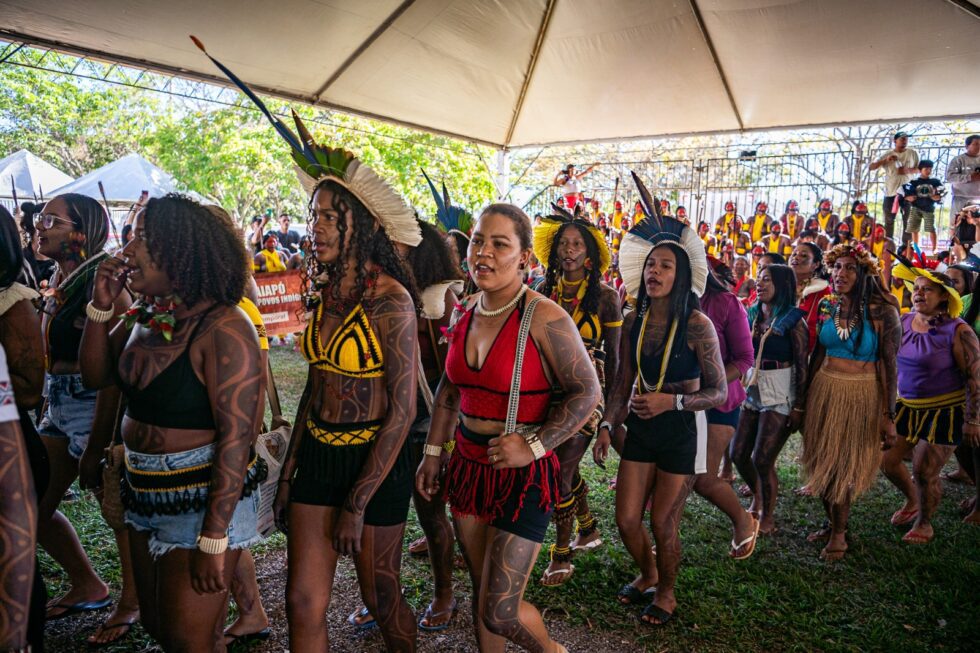
The march is a very significant moment for all these women and has gained strength, allies and supporters. During the days of the encampment, the agenda included themes such as gender equality, the defence of indigenous women’s rights, the conservation of the biomes, the demarcation of lands and the end of violence against original peoples. It is an arena for listening that has achieved significant progress in claiming the rights of indigenous women in Brazil.
The mobilization’s theme was “Women Biomes in Defence of Biodiversity through Ancestral Roots”. The act reasserted the women’s commitment to the preservation of their territories, ways of life and cultures. It was a moment that went beyond borders and approached women with objectives that united them and guided their struggles for justice and equality.
SEE WHAT THEY SAY ABOUT US
In the name of historical and structural racism, many people look at us, black women, and think that we aren’t competent, intelligent, committed or have no identity. Our experience with CESE is different. We are a diverse group of black women. We are in varied places and have varied stories! It’s important to know this and to believe in us. Thank you CESE, for believing in us. For seeing our plurality and investing in us.
Over these 50 years, we have received the gift of CESE’s presence in our communities. We are witness to how much companionship and solidarity it has invested in our territories. And this has been essential for us to carry on the struggle and defence of our people.
You have to praise CESE’s capacity to find answers so as to extend support to projects from traditional peoples and communities, from family farming, from women; its recognition of the multiple meanings of the right to land, to water and to territory; the importance of citizenship and democracy, including environmental racism and the right to identity in diversity in its discussion agenda, and its support for the struggles and assertion of the values of solidarity and difference.
When we hear talk of the struggles of the peoples of the waters, of the forests, of the semi-arid region, of the city peripheries and of the most varied organizations, we see and hear that CESE is there, at their side, without replacing the subjects of the struggle. Supporting, creating the conditions so that they can follow their own path. It is this spirit that we, at ASA, want you to maintain. We wish you long life in this work to support transformation.
CESE was set up during the most violent year of the Military Dictatorship, when torture had been institutionalized, when arbitrary imprisonment, killings and the disappearance of political prisoners had intensified. The churches had the courage to come together and create an institution that could be a living witness of the Christian faith in the service of the Brazilian people. I’m so happy that CESE has reached its 50th anniversary, improving as it matures.
I am a macumba devotee, but I love being with partners whose thinking is different from ours and who respect our form of organization. CESE is one such partner: it helps to build bridges, which are so necessary to ensure that freedom, diversity, respect and solidarity can flow. These 50 years have involved a lot of struggles and the construction of a new world.