8th Tapiri debates fundamentalism in Palmas, “Capital of Faith”
04 de April de 2025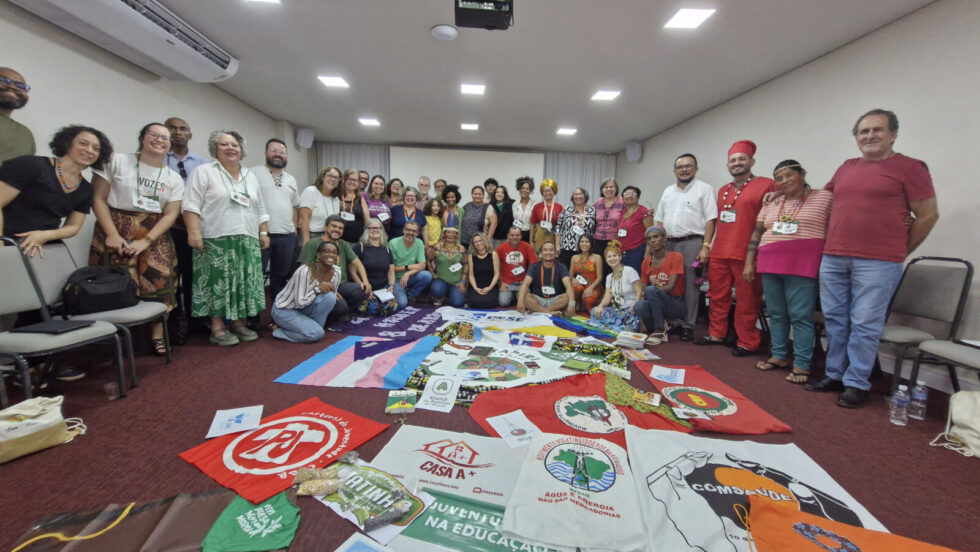
Between 26 and 28 March, CESE held the 8th Ecumenical and Inter-religious Tapiri, this time in Palmas (Tocantins), in association with another Ecumenical Mission, in defence of the families that live in the Rio Preto Quilombola Community in the rural area of Lagoa do Tocantins. The activity was supported by the Ford Foundation in partnership with the Process of International Networking and Dialogue (Processo de Articulação e Diálogo: PAD).
The Tapiri group also visited the Ilê Axé Omo Loira Silé worship house, in the neighbourhood of Taquaralto, for an ecumenical event, where representatives of various Christian churches and movements gathered with Mãe Iza.
Although it is known as the Capital of Faith, Palmas – and Tocantins in general – is the home of large-scale agribusiness enterprises and a fundamentalist alliance that incessantly attacks traditional territories. Almost all of the state’s territory is “dedicated” to MATOPIBA, evidence of political interests for the advance of agribusiness across the state. A huge platform of impunity.
During the first two days, the Tapiri brought together social movements, churches, members of the worship houses, traditional communities, quilombolas and indigenous people, black women, young people and the LGBTQIAPN+ population to better understand and draw up strategies to tackle the religious, political and economic fundamentalist alliance.
In several roundtables the debate was focused on how religious fundamentalism impacts on inter-religious dialogue in Tocantins and how this affects the struggles of these people. In addition to the movements, the roundtables were also attended by representatives of the State Public Defender’s Office.
Tapiri and the debate about fundamentalism
Isadora Reis da Rocha from the Young Environmental Educators’ Collective, shared the pain that she experienced 14 years ago, when she realised she was a young lesbian and was attacked by someone close to her.
“That shaped me. It showed me that violence happens when they try to destroy my identity, stop seeing me as a human being. I’ll make sure that person loses their self-esteem, self-knowledge, individuality, subjectivity, stop believing in their culture, sexuality, identity. What we have now is the result of that struggle, nothing has been given to us. A lot of people have died, killed themselves, hurt themselves for us to get here,” she said.
The quilombola Rita Lopes, President of the Rio Preto Quilombo, noted that people come to quilombola communities with a fixed idea.
“And expect us to fit this idea. Quilombos are places where faith came before religion. We aren’t people who like having labels. We have worship houses, but we have also have catholics and evangelicals. My people have always used religion as a strategy to resist. They’ve adapted so as not to die,” she explained.
An activist from the Landless Rural Workers’ Movement (Movimento dos Trabalhadores Rurais Sem Terra: MST), Antônio Marcos, talked about the diversity and challenges that constitute religiosity within the encampments and settlements.
“The movement’s discourse is against private property, which fundamentalists argue for tooth and nail. A moralism that attacks our ancestry. Bourgeois morality doesn’t fit with our culture. As we see in the various expressions of the people who make up our movement: gays, lesbians, trans people, black people, women, young people, the elderly, macumba followers.
“The MST trains citizens that the state has excluded from everything. We face the challenge of organizing people on the marches, on the walks, without losing faith. Let’s not fall into this duality of good and bad, right and wrong,” he added
Rio Preto Quilombo
Since 2023, the Rio Preto Quilombo, territory which received the 6th Ecumenical Mission and the 8th Tapiri, has faced intense conflict for its traditional lands in the former Caracol allotment. The dispute involves gunmen, ranchers, businessmen and local politicians, such as Cristiano Rodrigues de Sousa and the company Lagoa Dourada Participações e Serviços S/C.
The company, known for acquiring lands in disputed areas, uses violence to intimidate traditional peoples (in Portuguese), destroying farms, setting houses on fire and even setting off firearms around the community. The violence intensified following a legal decision in favour of the quilombolas in September 2023.
Amidst these clashes, the community obtained recognition from the Palmares Cultural Foundation as a quilombo remnant and a favourable opinion from the National Historic and Artistic Heritage Institute (Instituto do Patrimônio Artístico e Nacional: IPHAN) for the recognition of the Bom Jardim do Campo Santo Cemetery as an archaeological site. The oldest tombstone identified up to then dates back to 1919.
Despite this progress, Rio Preto continues to be intimidated today, receiving constant visits from the Tocantins environmental and military police. “When we want to do our slash-and-burn crop rotation, they threaten to fine us, they want to expel us. But when the company deforests everything for their sales, they don’t do anything,” a local leader reported. The community recently reported yet another arson attempt.
Despite all these struggles, the Ecumenical Mission was received with songs, a fantastic lundu circle dance and a bountiful table. Sônia Mota, CESE’s Executive Director, declared that all those present would ensure that the voices of the Rio Preto ring out and take what they have heard to the bodies that they access.
“We are here, from diverse places around Brazil, to demonstrate our solidarity. You already have strength. Your struggle inspires us. This is how we need to fight: with faith, courage and this resistance,” she asserted.
Supporters








Networks